Chinese Silver berry
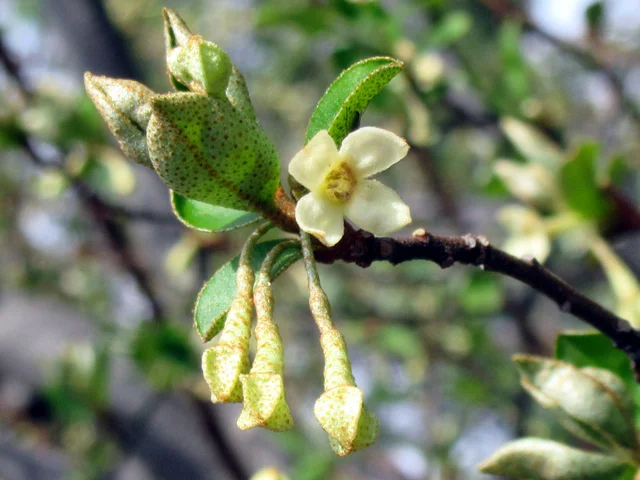 Location: East Gardens of th Imperial Palace
- Flower nameChinese Silver berry
- Scientific nameElaeagnus multiflora var. hortensis
- Aliasグミ, 茱萸, 唐茱萸
- Place of originJapan
- Place of floweringFields and footpaths
- Flowering seasonApril, May
What is Chinese Silver berry
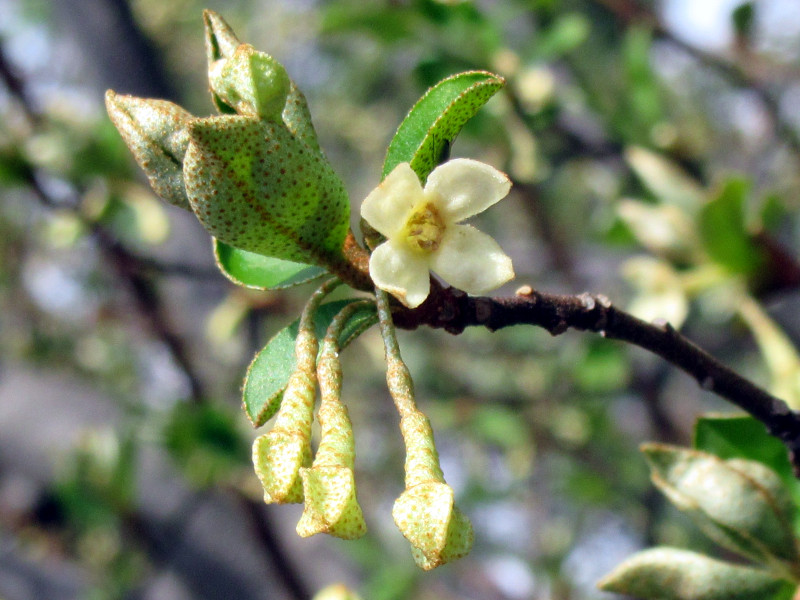
Chinese Silver berry(scientific name: Elaeagnus multiflora var. hortensis) is a variety of Elaeagnus multiflora, a small deciduous tree in the family Elaeagnaceae, native to Japan. It is also known as "Tou-gumi, kara-gumi" or "tawaragumi" in Japanese. The branches have no thorns. The leaves of the Chinese silverberry are small and oval, with silvery stellate hairs on the front and dense silvery scale-like hairs on the back of the leaf. It produces light yellow, tubular, flower-like sepals in spring and early summer. The flower-like calyx is a tubular calyx with four lobes at the tip. It produces sweet, delicious red fruits that can be eaten fresh in summer. The leaves turn yellow in the fall. Although the name "toe" is attached to the flower name, it is a garden variety native to Japan.
Another variety of E. multiflora is E. gigantea (scientific name: Elaeagnus multiflora var. gigantea, also known as E. gigantea). The fruits of E. multiflora are very large.
Common name: Chinese Silver berry, scientific name: Elaeagnus multiflora var. hortensis, origin: Japan, Height: 200cm.


- OrderRosales

- FamilyElaeagnaceae
- GenusElaeagnus
- SpeciesE. multiflora
- Type of flowerRadial symmetrical flower
- Array of flowerScattered inflorescence/ umbrella shape
- Petal shapewithout
- Leaf type
- Edge of the leafEntire
- Life typeDeciduous small trees
- Flower colorsCream
- Colors of the leavesGreen
- Fruit colorRed
- Height200.0 ~ 400.0 cm
- Diameter of flower1.0 ~ 1.0 cm