Cheirolophus crassifolius
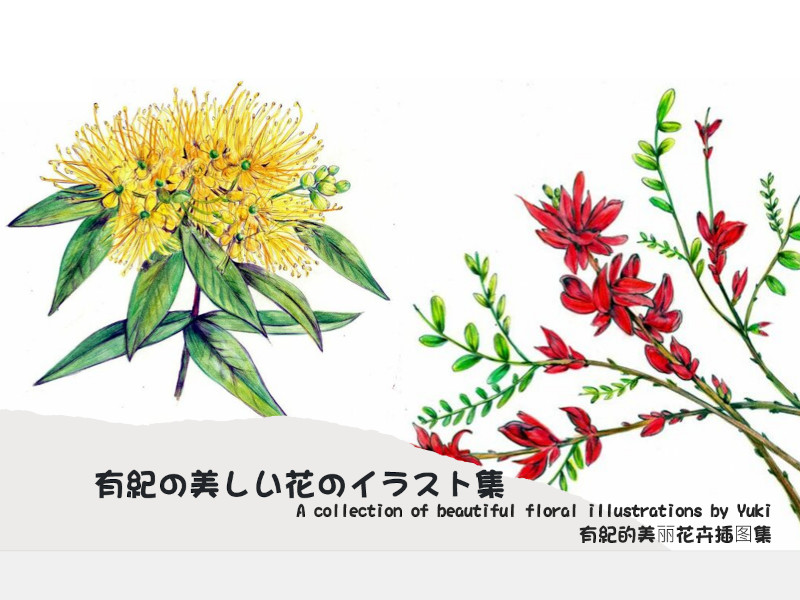
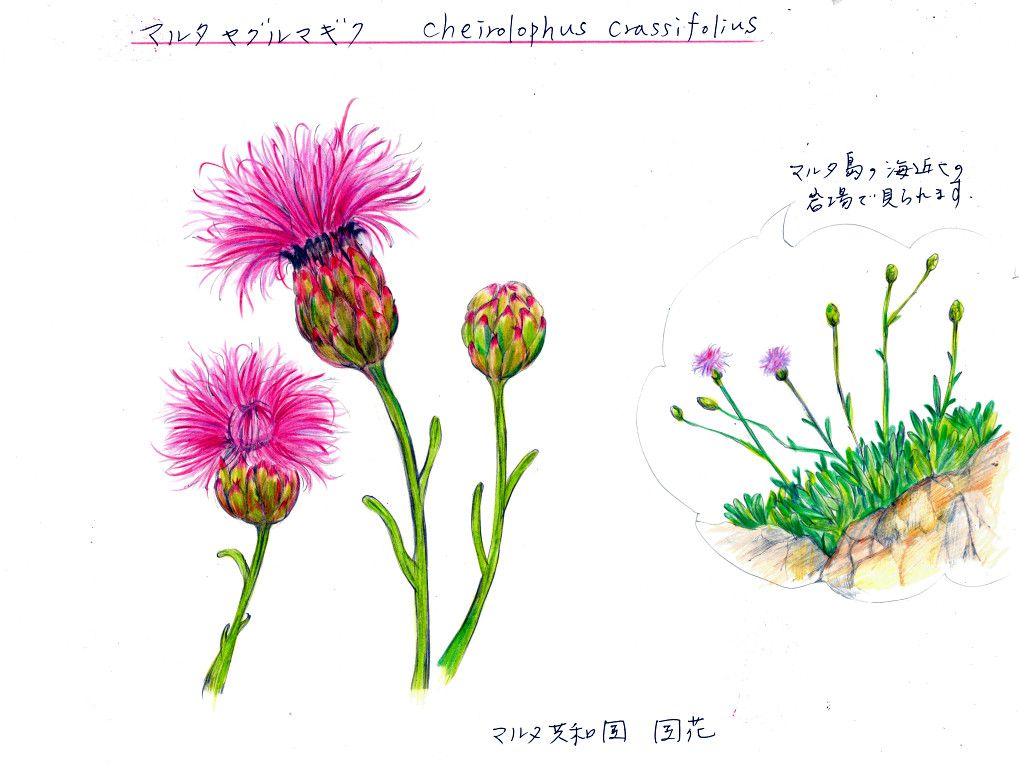
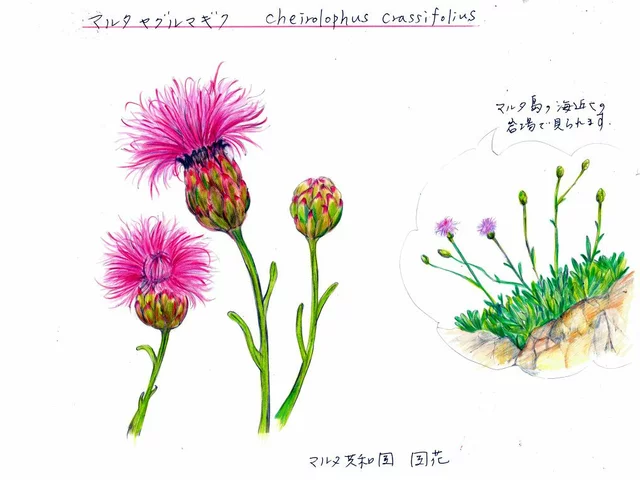 Location: Illust:Yuki @Kagiken (Science&Technology Inst.co.,Tokyo )
- Flower nameCheirolophus crassifolius
- Scientific nameCheirolophus crassifolius
- Alias:Maltese rock-centaury, マルタ ロック ケンタウリ, ケイロロフス・クラッシフォリウス, Cheirolophus crassifolius, Maltese centaury
- Place of origin endemic to Malta
- Place of floweringSpecific area
- Flowering seasonMay, June, July
What is Cheirolophus crassifolius
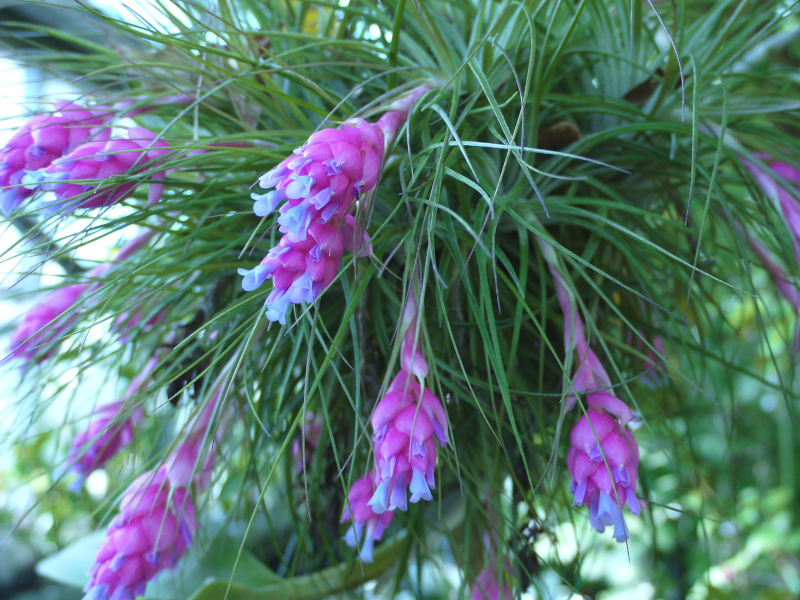
Cheirolophus crassifolius (scientific name: Cheirolophus crassifolius), endemic to Malta, is a perennial herb in the genus Cheirolophus (Asteraceae). It is native to limestone cliffs and deep coastal valleys, and was declared the national flower of Malta in 1973. The herb is 50 cm tall with erect stems that are branched at the top. The leaves are inverted lanceolate, thick-walled and rosette-shaped. It has palmate bracts and reddish-purple tubular flowers similar to those of thistles, but without spines. The genus name Cheirolophus = Cheiri (red flower), Cheir (hand) + lophus (crest of a cluster) = reddish purple flowers with thorn-like clusters. The species minor name crassifolius = crassi (thick) + folius = thick leaves.
It is an endangered species in the Maltese Islands. The cornflower (scientific name: Centaurea cyanus) is a member of a different genus (Cornflower).
Cheirolophus crassifolius , scientific name: Cheirolophus crassifolius, also known as Maltese rock-centaury, Cheirolophus crassifolius (Cheirolophus crassifolius), Maltese centaury, Maltese rock-centaury, Widnet il-Baħar (Maltese), Height: 50 cm, Stem: Green, without spines or hairs, Leafiness: Succulent Shape: spoon-shaped to inverted lanceolate; leaf length: 6 cm; leaf width: 1.5 cm; corolla shape: thistle-like with tubular flowers only; flower color: reddish purple; corolla diameter: 20-25 mm; flowering season: May to July.


- OrderAsterales

- FamilyAsteraceae
- GenusCheirolophus
- SpeciesC. crassifolius
- Type of flowerRadial symmetrical flower
- Array of flowerMonopetal inflorescence
- Petal shape
- Leaf typeInverted lanceolate
- Edge of the leafEntire
- Life typePerennial grass
- Flower colorsPurple
- Colors of the leavesGreen
- Fruit color
- Height150.0 ~ 200.0 cm
- Diameter of flower10.0 ~ 15.0 cm