Rubia argyi
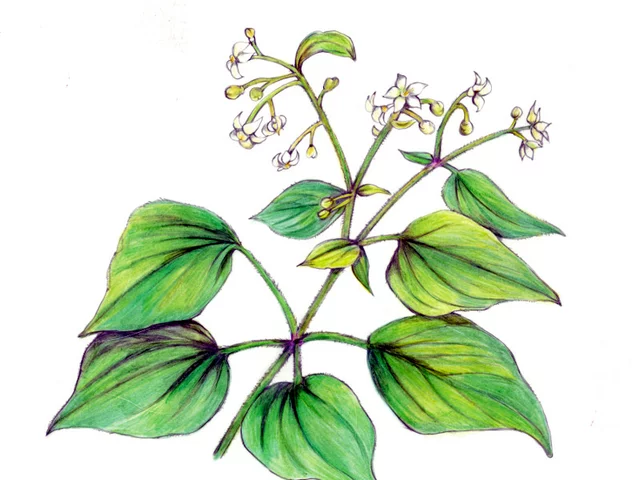 Location: Illust:Yuki @Kagiken (Science&Technology Inst.co.,Tokyo )
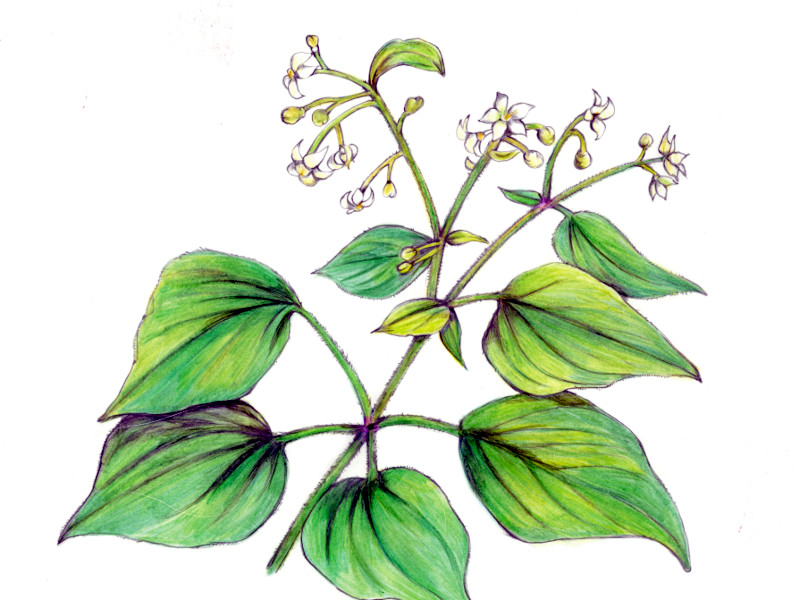
- Flower nameRubia argyi
- Scientific nameRubia argyi
- Alias茜葎
- Place of originChina to Japan
- Place of floweringFields and footpaths
- Flowering seasonAugust, September, October
What is Rubia argyi
Rubia argyi or akane (scientific name:Rubia argyi) is a perennial vine native to China to Japan in the family Rubiaceae. It grows wild in the mountains and forest margins of Honshu, Shikoku, and Kyushu. The vine is 1 to 3 m long, with a four-lobed stem that grows by wrapping around other plants. It produces minute pale yellow flowers from the stem tips or leaf axils from August to October. The roots are boiled and used as a dye for Akane dye, and the dried root is used as a herbal medicine called "senzokon". The young leaves are used as a vegetable.
It has been cultivated since ancient times, so much so that it is mentioned in the Manyoshu (The Anthology of Myriad Leaves). The Manyoshu has a poem about akane.
Common name: Rubia argyi or akane, scientific name: Rubia argyi, synonym: Rubia akane, habitat: Honshu, Shikoku, Kyushu, living environment: mountainous areas and forest margins, root color: red-yellow (fresh) to dark purple (when dry), vine length: 1 to 3 m, stem Tone: red; Root color: red; Leaf: single leaf; Leaf length: 3-7 cm; Leaf width: 1-3 cm; Leaf shape: heart-shaped with pointed tip; Stipule: 4-lobed; Petiole: long; Leaf underside: with opposite spines; Flower: joint flower; Inflorescence shape: compound clustered inflorescence; Corolla shape: wheel-shaped with 5 lobes; Flowering season: August to October; Flower color: pale yellow; Flower diameter: 0.3-0.4 cm Flowering season: August to October; Flower diameter: 0.3-0.4 cm; Number of stamens: 5; Flowering site: apex or leaf axils; Fruit diameter: 0.6 cm; Fruit shape: spherical; Fruit type: kernel with liquid fruit.


- OrderGentianales

- FamilyRubiaceae
- GenusRubia
- SpeciesR. argyi
- Type of flowerRadial symmetrical flower
- Array of flowerCompound scape inflorescence
- Petal shapeWheel-shaped
- Leaf typeheart-shaped
- Edge of the leafEntire
- Life typeperennial vine
- Flower colorsCream
- Colors of the leavesGreen
- Fruit color
- Height40.0 ~ 80.0 cm
- Diameter of flower0.3 ~ 0.4 cm